




Labeling Your Products : Lip Balm

Labeling your handmade products can seem so confusing. In this 3 part series, I am going to give some basic examples of how to label lip balm, cold process soap, and lotion so that you can confidently sell or give these products as gifts.
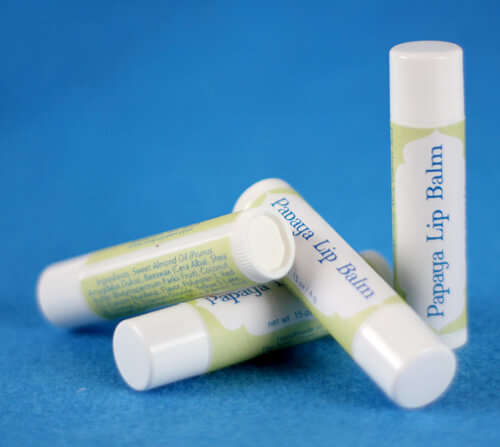
I am just going to be touching the tip of the iceberg though. There is more to know than I can explain in a few blog posts.  If you’d like to become a labeling ninja, I highly recommend the book Soap & Cosmetic Labeling by Marie Gale. It is a concise and easy-to-read book, full of examples about labeling cosmetics with a special emphasis on soap.

The FDA’s website has many interesting articles and you can read the law as it is actually written. They also have a free Cosmetic Labeling Manual that addresses all of the basics of labeling.

The Basics for Labeling Lip Balm:

1. Ingredients: The ingredients need to be listed from most used to least used. The exception to this is listing colorants -  those you can just add to the end of the list of ingredients. The names of the ingredients need to follow the INCI ( International Nomenclature of Cosmetic Ingredients) rules. This is the scientific or agreed upon standard name for the ingredient. There are actually a few different versions of these rules that are acceptable. Here, we are going to use the 6th edition rules of the INCI Dictionary.

2. Quantity: You need to list how much product is in the container. We are going to go by weight since lip balm is a solid product.

3. Who made it: You need to list the name of the maker of the product and where they are located. That means an address (not just a website).

And that’s it! Well sort of. There are more details and exceptions to the rule especially if you are making claims like ‘moisturizing’ or ‘heals cracked lips’. If you want to make those types of claims, your product will end up being considered an ‘over the counter drug’ and you will definitely want to do a little more research in books and on the FDA website.

For our first example we are going to learn how to list the ingredients for a lip balm:

My recipe is:

This post does not explain how you make lip balm – but how to label it after you’ve made it (but if you’re curious, check out how to make lip balm here).

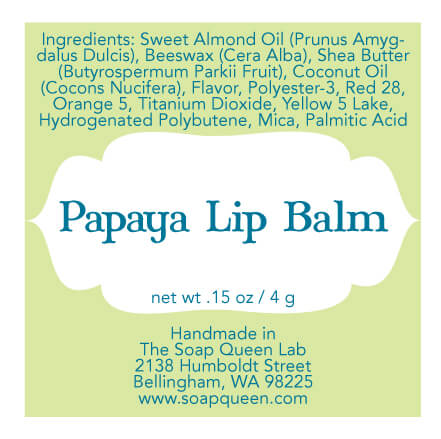
For the above recipe, the label would look like:

Ingredients:  Sweet Almond Oil (Prunus Amygdalus Dulcis), Beeswax (Cera Alba), Shea Butter (Butyrospermum Parkii Fruit), Coconut Oil (Cocons Nucifera), Flavor, Polyester-3, Red 28, Orange 5, Titanium Dioxide, Yellow 5 Lake, Hydrogenated Polybutene, Mica, Palmitic Acid

There are a few different ways to list the ingredients that are legal. I prefer the 6th edition rules because it combines the botanical name (which is standardized) and the Common name (which is easy to understand). The 2nd, 6th and 8th edition rules are all legal and accepted by the FDA.

Notice that the ingredients are listed in order of quantity from most used to least. In the case of the Shea Butter and Coconut Oil, since the same amount is used, you just pick one to list first. Also notice that the INCI for the colorants are just added at the end. It doesn’t matter what order they are in.
And that concludes this first very basic overview of labeling. I hope it’s a little less intimidating now. In the next part of this series, I will show how to label your cold process soap and handmade lotion.

If you like these little labels they are available as a free download on the Bramble Berry website.

57 Responses to “Labeling Your Products : Lip Balm”

  1. LaQuetia says:

    Thank you for this information. I am always unsure about labeling and this is simply explained and really understood.

  2. Jen L says:

    Love this post! I had no idea of the labeling requirements and am now redesigning mine. Thanks :)

  3. Charity says:

    Are the requirements different for “big business” versus “small business?” Because in looking at the soaps, bath salts, lip balms, etc, that I have, there is no full address – just a company name, city/state/country, and a website, or in some cases just a website with the company’s name on it. And these are from well-known brands/stores!

  4. Charity says:

    Oh – and what if your colorants do not say what they are? The colorants I have don’t have any indication of what they are made of – they’re just colors.

    • Anne-Marie says:

      Your vendor should be able to give you that INCI information and tell you if they’re safe for lip balm. =) And if they can’t? Tough love but I’d switch vendors.

      • Robin says:

        Hey another question off the subject. Where do the avatars come from? I would like to change the picture and can’t remember if it is yahoo or where? THANKS!

  5. Margo says:

    This is a good informative article, thank you for posting it for us. What type of labels do you recommend to purchase in order to print these out on?

  6. Meredith Bretz says:

    Can you give info on the font size/type? Sometimes that can be an issue-getting the required info on a small space.

    • Anne-Marie says:

      The size of your lettering depends on the overall size of your label and what part of the label you are talking about. For instance, the name of the product must be the most prominent part of the label but the exact size is determined by the size of the label and the size of the other information on that label.

      So for this label size the type must be at least 1/32″ for the ingredient listing. Of course, if your printer can’t clearly print the letters that small then you need to make it big enough to be legible.

  7. Linda says:

    Thanks, Anne-Marie! The timing on this series is perfect, because I’m just starting to make lotions and other products in addition to CP soap. Hope your family has a happy & blessed Thanksgiving!

  8. Linda says:

    This is awesome and so needed!! I love the template but are they an Avery standard size? or what type of label do you use? Thanks so much. This has been a very difficult obstacle trying to fit everything into a small space. Thanks!

  9. Pam says:

    Great blog thanks!

    Is lip balm a cosmetic? If the color and flavor are left out where is the cosmetic component?

    Thank you for any clarification as this is a mystery to me.

    • Anne-Marie says:

      Yes, lip balm is considered a cosmetic. Anything that is meant to be applied to skin is a cosmetic with the exception of bar soap. The term ‘cosmetic’ doesn”t just mean makeup like lipstick or eye-shadow it also refers to lotions, perfumes, etc.

  10. Mitchell says:

    I’ve been reading that if someone uses the word “balm” it implies healing, which makes it a drug (OTC) in the eyes of the FDA. Supposedly, you have to pay a ton of money to have it fall within regulations.

    I know you can’t answer all of the questions, but it’s just so crazy. Looks like I’m going to have to pick up that book on cosmetic labeling you mentioned.

    • Anne-Marie says:

      A product is considered a drug if it makes a claim. Curing acne, reducing wrinkles and moisturizing dry skin are all claims, so if you state that on your packaging you need to label your product as an Over The Counter drug.
      However, the term balm is not a claim on its own. But if you put ‘moisturizing balm’ on your label then you would need to follow OTC labeling guidelines.

      • Mitchell says:

        Thank you for clearing that up. I was fretting about the word Balm in Lip Balm, because nothing else sounds good. I was thinking Lip Stuff, Lip Wax, Lip… Can’t wait for the other parts in this series! Great work!

  11. brooke says:

    I agree, good timing and thank you. I now need to fix all my labels! I went and read the cosmetic section of the FDA website and am fairly well informed now. I have a question/survey, though. The FDA does not require that cosmetics are tested for bacteria, etc, but if you do not test your product, you are required to put that specific warning on your label. My question is, how many of you are: 1) putting the warning on your labels, 2) actually having every batch officially tested, 3) neither?

  12. Rebecca Berman says:

    So do I have to label if I’m giving as a gift? Or only if I’m selling. I was wanting to make and give some lotion bars as Christmas gifts this year.

    • Anne-Marie says:

      That’s a great question, Rebecca. To be squeaky clean on the law side, technically, yes, you’d need to label buuuuuuut, far be it from me to suggest not following the letter of the law but if you’re doing test batches, gifts and non-selling products, a cute *simple* label should do the trick. Ingredient labeling is designed for full disclosure for the buying public when they are comparing products on the shelves. When you are giving products to friends and family, you’ll still want to be aware of the concerns with allergies so labeling with basic ingredients is the best, most safe option for you but many, many small test batches have been done in the past with little to no labeling so do the most you can, be merry and call it good.

      Note to anyone reading this that’s even contemplating selling – you, my friends, need to label with full ingredients =) This was only for small one-off gift batches with hobbyists so don’t get too excited.

      • Anne-Marie says:

        One more thing I just thought of:

        If you put ‘not for resale’ you don’t have to
        put the ingredients on the container. Ingredient labeling is `purely for items that are to be sold. In fact, many items sold in Salons don’t need to
        have ingredients because they are being sold to professionals and not the general public.

  13. [...] on labeling your soap and beauty products. It will be a 3 part series. The first one on how to  label your Lip Balm.  The second howto is on “How to Label Cold Process Soap” and you can read this [...]

  14. Michelle says:

    What is the best way to get the weight consistent on each lip balm etc.

    • Anne-Marie says:

      If you go with the same volume each time to fill up your tubes each time (so 2 dropperfuls for example), that will keep your weight pretty steady or if you use the same fill line (always filling flush with the top of the lip balm for example), that will keep an accurate weight as well.

  15. Michelle says:

    Thanks for the great post.

    I love this label design, what program was it done in? The text box for the title is adorable.

  16. Nicole says:

    I don’t know if you will know this answer, but I was reading on a company’s website that sells pigments and colorants for cosmetics, that when using FD&C dyes they need to be “batch certified” to be sold in a product. The large amounts they recieved before selling were batch certified but once opened, they no longer were. How can someone tell the difference between those dyes and dyes that are in micas? And what about the dyes/pigments that are on BB? Like the Yellow 5 Lake listed is a FD&C dye but is in the yellow mica. But if it was just the pure dye it would have to be batch certified. They had a link to information on it, but it’s not working anymore. Everything is just so confusing, I don’t think I’ll ever end up selling. From understanding all this, to licensing etc. Blah.

    • Anne-Marie says:

      Hi Nicole,

      All dyes for cosmetics are held for batch certification. These are big master batches from the manufacturer. Once they are broken into smaller containers or made into liquids they do not need batch certification.

      Does this answer your question?

      Don’t stress too much – get a business license for your state and your city, work your homeowners insurance policy to see if they will cover you to manufacture and sell products and you’re off to the races! =)

      • Judith says:

        …so a colorant that is batch certified to the supplier (say: Brambleberry!) may be used in cosmetics made and sold by people who purchase the colorant from the supplier? It would be nice to have the say-so in simple English as recently I’ve read things that say otherwise, without direct citation. I hope you can clear this up!

        • Anne-Marie says:

          If I’m understanding your question correctly, if the end user is using it in the correct product, you should be good.

          So, for example, if the colorant isn’t approved for use in lip balm, then no amount of certification will allow you to use a certified colorant in lip balm.

          I hope this helps!

          • Judith says:

            Thank you, it does. It didn’t make sense to me that home crafters/small businesses couldn’t use batch certified colors like lakes or micas in (appropriate) products for sale if the supplier had broken them down to saleable sized lots. (Which was what I had been told.)

  17. Gabi says:

    My friend and I both share a business that’s not huge. Which address goes on the product- hers or mine?

  18. Gabi says:

    If you’re adding a colorant to your products and labeling and selling, are there additional and special rules. I learned they’re last in the ingredients list but all the questions about.colorants and FDA rules are confusing me.

  19. Gabi says:

    My prodcuts would be considered a drug and a cosmetic. I went through the many rules and am wondering, where exactly do you get that common “drug facts” label and fill it in with your information.

  20. clmkids says:

    How many labels for the lip balm tubes can you get out of one label sheet?

  21. Jasmine says:

    Do they only come in this design, or are there other colors and shapes?

  22. Curtell says:

    I wanted to know do we have to label using the long name of an ingredent such as beeswax(cera alba).

    • No, you don’t. There are a few different ways you can label your products and currently they are all considered legal (confusing, I know). One of these ways is to just use the common name of the product. I would highly recommend reading Marie Gale’s book, we can’t possibly pack all of the great info she has in a few blog posts. Thanks!

  23. Stacy Static says:

    This is really good but here’s my problem. If you’re making a large batch to fill multiple tubes at once, then how do you know or figure out the proportions for each tube?

    • Anne-Marie says:

      Great question – the ingredients are all mixed up together and so that means, the same proportions (percentages) in the big batch are the same in each little tube. Does that make sense? Let me know if I need to clarify it more =)

  24. Toni Babcock says:

    I am not sure if you would be able to answer this but I have made an acne repair that only has co’s and eo’s in it. I would assume this would fall under the cosmetic is also a drug but I cannot figure out how I would label it. Do you have any suggestions. Also, is a lotion a cosmetic or a cosmetic/drug and do you know where I could find info on how to label those. Thanks!

Leave a Comment

(Your email address will not be published)

Soap Queen Newsletter Signup

Enter your email address

Soap Queen Lab