





• April 14, 2016

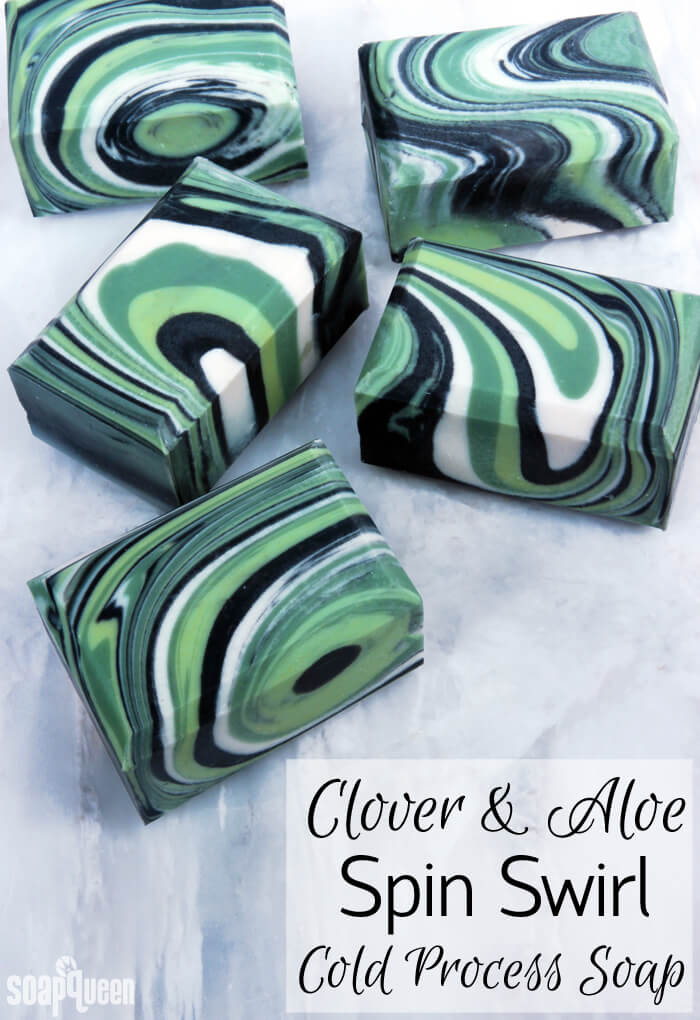
Learn how to create gorgeous Clover and Aloe Spin Swirl Soap in this video tutorial. The spin swirl involves spinning the mold to create a unique swirl each time.

The spin swirl technique refers to pouring layers of soap into the mold, then spinning the soap to create a unique design. The key to the spin swirl is a slow-moving recipe and fragrance oil that does not accelerate trace. This Clover and Aloe Spin Swirl Soap is made with the new Clover and Aloe Fragrance Oil, which behaves wonderfully in cold process. I also like to use a lazy Susan for this project – it really helps with spinning motion!

If you’re a beginner soaper, I would recommend getting a few recipes under your belt before attempting this project. The soap batter must stay fluid for a long period of time, so a good understanding of trace is essential. If you’re looking for more spin swirl tutorials, check out the Psychedelic Spin Swirl Cold Process Soap and the Pantone Spin Swirl Cold Process Soap for more inspiration.
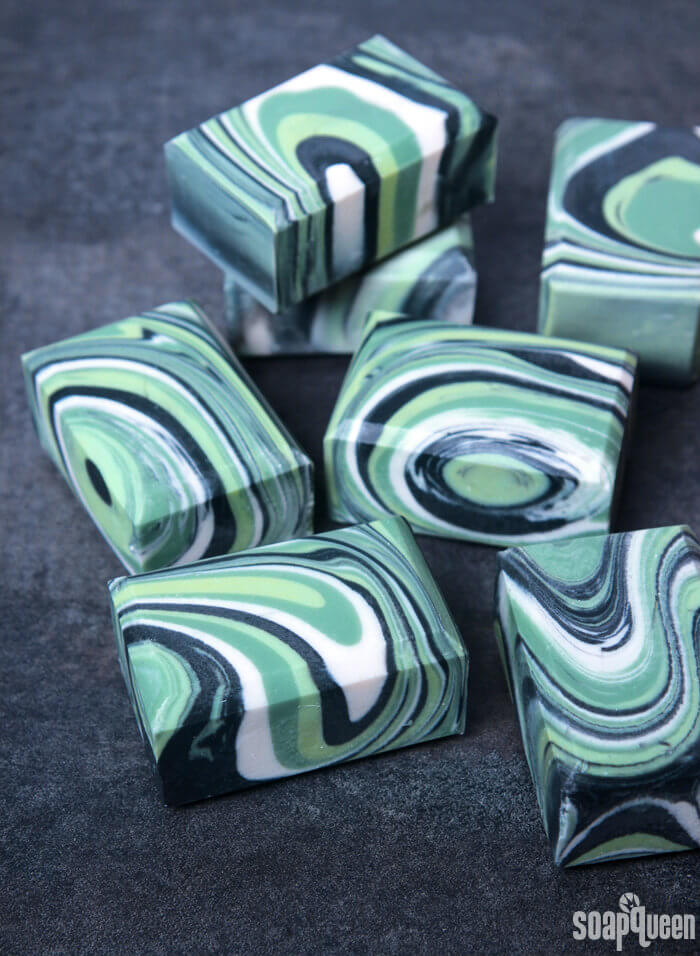
Learn how to create gorgeous Clover and Aloe Spin Swirl Soap in this video tutorial. The spin swirl involves spinning the mold to create a unique swirl each time.

What You Need: 
9 Bar Birchwood Mold + Dividers

Silicone Liner for 9 Bar Mold
16 oz. Canola Oil (40%)
0.8 oz. Castor Oil (2%)
8 oz. Coconut Oil (20%)
8 oz. Palm Oil (20%)
4 oz. Rice Bran Oil (10%)
3.2 oz. Sweet Almond Oil (8%)
5.5 oz. Sodium Hydroxide Lye
13.2 oz. Distilled Water
2.5 oz. Clover and Aloe Fragrance Oil
Titanium Dioxide
Kermit Green Mica
Evergreen Mica
Black Oxide
Optional: Sodium Lactate


Click here to add everything you need for this project to your Bramble Berry shopping cart!
[sq_products]
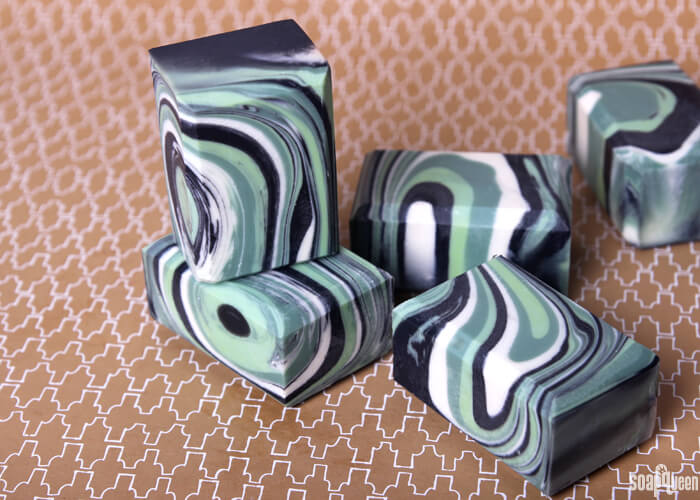
Learn how to create gorgeous Clover and Aloe Spin Swirl Soap in this video tutorial. The spin swirl involves spinning the mold to create a unique swirl each time.

Clover & Aloe Spin Swirl Cold Process on Soap Queen TV

Soap Queen
This Clover & Aloe Spin Swirl Soap features lots of layers and a fresh scent.
Cook Time 2 hours
Total Time 2 hours

Ingredients
  

  • 9 Bar Birchwood Mold + Dividers
  • Silicone Liner for 9 Bar Mold
  • 16 oz. Canola Oil 40%
  • 0.8 oz. Castor Oil 2%
  • 8 oz. Coconut Oil 20%
  • 8 oz. Palm Oil 20%
  • 4 oz. Rice Bran Oil 10%
  • 3.2 oz. Sweet Almond Oil 8%
  • 5.5 oz. Sodium Hydroxide Lye
  • 13.2 oz. Distilled Water
  • 2.5 oz. Clover and Aloe Fragrance Oil
  • Titanium Dioxide
  • Kermit Green Mica
  • Evergreen Mica
  • Black Oxide
  • Optional: Sodium Lactate

Instructions
 

SAFETY FIRST: Suit up for safe handling practices! That means goggles, gloves, and long sleeves. Make sure kids, pets, and other distractions and tripping hazards are out of the house or don’t have access to your soaping space. Always soap in a well-ventilated area.

    COLOR PREP: To ensure that the titanium dioxide blends smoothly into the soap batter, we recommend micronizing it before dispersing it in oil. Please note this is an optional tip but it does help with the titanium dioxide clumping in the soap.To micronize colorant, simply use a coffee grinder to blend the colorant to break up any clumps of color and prevent streaks of white from showing in the final soap. We like to use a coffee grinder that has a removable, stainless steel mixing area for easy cleaning. Disperse 2 teaspoon of the colorant into 2 tablespoon of sunflower or sweet almond oil (or any other liquid oil). Then in separate containers, disperse 1 teaspoon of the Black Oxide and 1 teaspoon of Evergreen Mica into 1 tablespoon of lightweight liquid oil. Finally, disperse 2 teaspoons of Kermit Green Mica into 2 tablespoons oil. Use a mini mixer to get rid of any clumps.

      FRAGRANCE PREP: Measure 2.5 ounces of Clover and Aloe Fragrance Oil into a small glass container and set aside.

      • Slowly and carefully add the 5.5 ounces of lye to 13.2 ounces of water and gently stir until the lye has fully dissolved and the liquid is clear. Set aside to cool. If you’d like a harder bar of soap that releases faster from the mold, you can add sodium lactate to the cooled lye water. Use 1 teaspoon of sodium lactate per pound of oils in the recipe. For this recipe, you’d add 2.5 teaspoons.
      • Melt and combine the 16 ounces of canola oil, 0.8 ounces of castor oil, 8 ounces of coconut oil, 8 ounces palm oil, 4 ounces of rice bran oil, 3.2 ounces of sweet almond oil and 8 ounces of palm oil (remember to fully melt then mix your entire container of palm oil before portioning). Once the lye water and the oils have cooled to 130 degrees or below (and are ideally within 10 degrees of each other), add the lye water to the oils and stick blend until a very thin trace.
      • Be careful to not over emulsify the batter. The soap batter should be very thin. You can always stick blend more later. Split the batch into four containers. Each container will hold about 400 mL.
      • To one container, add 1 tablespoon dispersed titanium dioxide. To another add 2 tablespoons of dispersed Kermit Green Mica and 1/2 teaspoon titanium dioxide. To the third container, add 2 teaspoons of Evergreen Mica. To the final container, add 1 teaspoon of dispersed black oxide. Use a whisk to mix in the colorants.
      • Add the Clover and Aloe Fragrance Oil to each container evenly - it's okay to eyeball it.
      • Now it’s time to pour. We like to place the mold on a Lazy Susan to help spin the soap. The order in which you pour the colors into the mold is up to you. We like to pour two contrasting colors into opposite corners of the mold at the same time. Continue to pour varying colors into the corners of the mold.
      • Count to three during each pour to help pour an even amount. Pour color in the opposite corner of the mold, counting to three to help pour evenly. Start pouring various colors into both corners of the mold. As you layer the colors, the soap is pushed toward the center of the mold. Work as quickly as possible during this process, as the soap will continue to thicken up with time. Every now and then, give the colors a whisk to help keep them fluid. Jiggle the mold to loosen up the soap if it begins to mound up.
      • Once all the colors have been poured into the mold spin the Lazy Susan, stopping it quickly to help give the soap movement. You want the centrifugal force created by the spin and stop movement to move the soap in various directions within the mold. Be careful not to spin too hard, or the soap may spill out of the mold.
      • Continue swirling until you’re happy with the pattern. Be careful to not over-swirl the soap, or the colors will muddle together.
      • Once you’re happy with the swirl, place the divider set into the mold until it reaches the bottom. Spray the top of the soap with 99% isopropyl alcohol to help avoid soda ash.
      • Let the soap stay in the mold for about 4-5 days.
      • Remove the silicone liner from the wood mold. Pull the silicone liner away from the soap to release the airlock. Push the entire slab of soap out. If it's still quite soft, allow it to sit upside down for 1-2 days to harden.
      • Gently remove the soap from the dividers. To prevent tearing, do not pull the dividers. Push the soap down, or slide the dividers up or down to remove the soap without tearing. Allow the soap to cure for 4-6 weeks, and enjoy!
      Tried this recipe?Let us know how it was!

      You may also like these

      Become an email subscriber

      Enter your email address below and you will receive all our new posts directly in your email inbox.

      1. Is there a pdf format or text version of the instructions? I have all the materials and don’t want to have to screenshot the video or watch it over and over again

      2. Hey 🙂 I was wondering if there was an easy way to identify which frangrances will speed up trace?

        1. Yes, you can put the lid on this soap and place it on a heating pad set to medium for 20 minutes. Turn it off after then but leave it on the heating pad. If it’s pretty cold in your house, you can also cover the mold with a towel or blanket.

          Learn more about insulating soap here: https://soapqueen.com/bath-and-body-tutorials/tips-and-tricks/when-to-insulate-handmade-soap/

          And more about gel phase here: https://soapqueen.com/bath-and-body-tutorials/tips-and-tricks/gel-phase/

      3. I made this recipe but used the following BrambleBerry colors: Titanium White, Kermit Green, Racing Stripe Orange, Lemonade and 2.9 oz Kumquat Fragrance. It reminds me of creamsicles. I’m one day in the 9 bar mold and it looks great!

      4. I bought the Silicone Liner for 9 Bar Mold & 9 Bar Birchwood Mold + Dividers. My bars didn’t come out with the nice beveled edges pictured in the tutorial. Was I given the wrong mold?

      5. Oh I didn’t want my real name on this comment but it auto did it. Is it okay if you delete these two comments please?

      6. Wow love watching you tutorials!!
        I’m a newbie and this video answered lot of questions but I still have one. Did you discount water for this recipe? Because I have seen soap makers doing that when using titanium Dioxide. Or is just when using titanium Dioxide diluted in water? I’m so confused.
        Thank you

        1. This recipe is not water discounted. You can discount for a number of reasons – if your recipe contains titanium dioxide, if it has a puree with extra water, or if you just want it to harden faster. Learn more about water discounting here: https://soapqueen.com/bath-and-body-tutorials/tips-and-tricks/water-discounting-cold-process-soap-how-why/

          Water discounting does accelerate trace though, which would affect this recipe. It needs a very slow trace to get the design.

          -Kelsey with Bramble Berry

        1. Castor oil is unique and there is no direct substitute for it. It’s a thick oil that adds lather to the bars. If you like, you can add more canola. Just keep in mind the bars won’t bubble as much. Also, make sure to run the recipe through the Lye Calculator after any substitutions!

          Lye Calculator: https://www.brambleberry.com/Pages/Lye-Calculator.aspx

          Learn more about substituting oils in cold process soap here: https://soapqueen.com/bath-and-body-tutorials/tips-and-tricks/how-to-substitute-oil-in-cold-process-recipes/

          -Kelsey with Bramble Berry

      7. Are there printable directions anywhere for this recipe? I try not to keep my laptop to close when I am soaping…I’m sure you can imagine why! I just bought the ingredients to make this soap and can’t wait to make it.

      8. Do you think the spin and swirl would work with the shampoo bar recipe?
        Also, could I use activated charcoal for the black colorant and Zinc oxide for the white colorant?

      9. Hi, a great many of these geocentric or spin recipes use canola oil. I get that it is thin and moves well in the thin designs and patterns, but I hate canola oil. Is there something other than sunflower oil that you think would work as a similar fluidity in the soaping? I have lots of nut oils, palm, coconut, tallow, olive, rice etc. I was wondering about rice bran oil as a sub? Thanks.

        1. Hi Kirsten!

          You can use any slow-moving liquid oil! Both olive oil and rice bran oil work nicely. Oils that are liquid at room temperature give you time to work with the design. In this recipe, you can replace the canola oil with olive oil. Just make sure to run the recipe through the Lye Calculator after any substitutions. 🙂

          Lye Calculator: https://www.brambleberry.com/Pages/Lye-Calculator.aspx

          This post has more information on oils that work well for swirling soap: https://soapqueen.com/bath-and-body-tutorials/tips-and-tricks/five-tips-swirling-cold-process-soap/

          And this post has tips on substituting oils in cold process soap: https://soapqueen.com/bath-and-body-tutorials/tips-and-tricks/how-to-substitute-oil-in-cold-process-recipes/

          -Kelsey with Bramble Berry

      10. My spin swirl didn’t spin…..I don’t know what happened. I used the same exact recipe and used the fragrance Blueberry Jam which was wonderful to work with. When I started pouring my colors they just started to meld together……no rings like in the picture. I kept on going though and it’s really very pretty but not what I wanted. And the fragrance is to die for. I’m wondering if I didn’t stir the batter enough. I know I did emulsifying the lye water and oils. I finally unmolded it this morning (after leaving it upside down as I’ve heard Ann Marie suggest) and it felt like melt and pour that is sweating. At first I thought a little water got on a few bars because I was near the sink but all the bars had it……they were wet with I don’t know what. The top and a few of the bottoms of the bars were fine though. I don’t understand……can you help me with this? What could it have been? I put them on the rack this morning and they’re fine now……strange

        1. Hi Deb!

          Hmm, I’m wondering if the soap wasn’t quite emulsified. That can make it pretty thin, which causes the colors to mix together rather than pool on top of each other. It may also be the reason they were wet – that can sometimes be the soap separating. Do the bars look fine now? If so, they should be just fine to use! I would recommend pH testing them after 5 days just in case: https://soapqueen.com/bath-and-body-tutorials/tips-and-tricks/test-ph-red-cabbage/

          For the next batch, I would recommend alternating pulsing and stirring with the stick blender. You want the batter to be thin, but have no streaks of oil. It should be a nice tan color throughout. You can see an example of thin trace in this post: https://soapqueen.com/bath-and-body-tutorials/tips-and-tricks/trace/

          Let me know how that pH test goes! 🙂

          -Kelsey with Bramble Berry

          1. Hi Kelsey, the bars look fine now (the Blueberry Jam smells so good!) and I did a zap test (no zap) because I didn’t have any red cabbage???? I also did a ph test and the bars are a 9 so I guess I’m good to go.
            Thanks!

            1. That’s awesome, you are definitely good to go! Enjoy your lovely handmade soap. 🙂

              -Kelsey with Bramble Berry

      11. Is the 3.2 oz of Almond oil for the colors or part of the batter recipe?

        1. Hi Christine!

          Good question! The 3.2 ounces of sweet almond oil is part of the recipe, and does not refer to the oil used for the colorants. We generally don’t count the oil used to disperse colorants in our recipes; we consider it to be a little bit of extra superfat :). I hope this helps!

          -Amanda with Bramble Berry

      12. Oh my g did I blow this one! Lumpy lumpy lumpy! I have made a few batches of soap already and now that I think about it, they have all been pretty thick but not as thick as this sad batch. I haven’t used colors until this batch but I have used both FO and EO. How in the heck do I keep my from getting SO thick? I soaped with my oils and lye at 115 degrees and my house at 72 degrees. I did use different FO mix of several oils (including the lavender EO 42 from you all) – each were supposed to NOT accelerate. I have read that if I want to maintain slow trace oils and lye should be much cooler- do you think that would help? Or should I only use one FO and not mix? Maybe I’m stick blending too much?

        1. Hi Cathy!

          I’m sorry about that! There are a few factors that can cause acceleration. Typically fragrance oils are the culprit, but the ones you were using sound fine! How long did you stick blend for?

          -Kelsey with Bramble Berry

          1. Hey Kelsey, thanks for your reply.

            After doing more research, I’m thinking too long 😐

            I tried to do another batch after I wrote my original email, and it came out even worse! Let’s just say I had a frustrating and expensive weekend! Boo hoo!

            How long should I stick blend if I’m doing swirls? I’m always afraid I won’t mix enough and my soap will have lye pockets in it.

            1. Depending on the recipe, it can take just about 30 seconds to get everything emulsified! What we like to do is pulse several times then stir with the stick blender head. Pulse on and off with the stick blender head for about 30 seconds. Then, check the soap. If you see any streaks of oil, give the soap another pulse. When you have reached thin trace, the soap will be mixed but it will be very thin – sort of like thin cake batter.

              This post has more information on trace: https://soapqueen.com/bath-and-body-tutorials/tips-and-tricks/trace/

              And this video shows a really good example of thin trace: https://www.youtube.com/watch?v=Ea-UXZMXM1I

              You can see how thin the soap is as it’s being poured into the containers to have color added. To keep it thin, we also recommend whisking in colors and fragrance rather than stick blending.

              Temperatures help as well! We like to have our oils and lye around 115-120F. That keeps everything nice and melted during the process and allows you some time to work with your design. 🙂

              Learn more about temperature in this post: https://soapqueen.com/bath-and-body-tutorials/tips-and-tricks/back-to-basics-how-temperature-affects-cold-process-soap/

              -Kelsey with Bramble Berry

          1. Thanks for this info! I usually bevel mine shortly after unmolding if the bars are firm enough to be handled, but I didn’t know if there was some sort of standard for when was best. I appreciate your guidance! 🙂

        1. Hi Cindy!

          We haven’t given that a try, so I’m not entirely sure! The key to getting nicely defined melt and pour swirls is temperature. When the soap is around 130F, it’s cool enough to not mix with the other colors but not so cool that it’s too thick. I would recommend pouring your colors at that temperature and giving the mold a few turns to see how it works! 🙂

          Read more about swirling melt and pour soap here: https://soapqueen.com/bath-and-body-tutorials/tips-and-tricks/tips-for-swirling-melt-pour-soap/

          -Kelsey with Bramble Berry

        1. Hi Martina!

          We will get those percentages added to the recipe! It’s a new thing for us so we try our best to remember to add them each time. Sorry about that.

          -Kelsey with Bramble Berry

      13. I love the colors! And the clover and aloe smells amazing, I can’t wait to make something with it. Maybe I’m ready to do a spin swirl now – you make it look so easy!

        1. So glad you love the soap Michael! The spin swirl technique is a lot of fun, I hope you get a chance to give it a try. 🙂

          -Kelsey with Bramble Berry

      Comments are closed.

      {"email":"Email address invalid","url":"Website address invalid","required":"Required field missing"}

      The Latest from Soap Queen TV

      Inspired by Gems & Crystals

      All About Essential Oils

      The Power of Charcoal

      Create Your Own Clay Face Mask

      DIY Bath Bombs

      Cold Process Soap Tips & Tricks

      Learn the Basics of Cold Process Soapmaking

      Learn the Basics of Melt & Pour Soapmaking

      Want to Start Your Own Soap Business?

      Soap Business Success Stories

      Soap Queen TV Favorites

      Ingredient Spotlight

      Disclosure

      Unless stated otherwise, all images are original material and are copyrighted. If you'd like to use an image, please be a friend and credit the photo and link back to Soap Queen. Feel free to share, tweet and pin to your hearts content.