




Selling Melt and Pour Soap
by Kim of Pepo Park
Congrats! The soaping bug has bitten and you want to spread your love for melt and pour soap. Be sure to check out part 1 and 2 of the series (here and here).
You shouldn’t rush to get your soap to market until you know all about your soap and fortunately, it’s easier to do with melt and pour than with cold process soap.
Scent and color: Melt and pour base with lower melting points hold low-flashpoint scents better than bases with high melting points. On the Bramble Berry site, all essential and fragrance oils have their flashpoints listed. Once you know the melting point of your base, you should be able to figure out if your scent will flash out or not. Color can be tricky. Any FD&C colors are dyes and dyes bleed. This is only an issue if you use more than one color in your soap (or if you care). Labcolors are dyes and they create bright colors. There are several articles on the Soap Queen site about their usage. Oxides, ultramarines and clays don’t bleed and natural micas are another non-bleeding colorant choice. However, some micas are tinted with FD&C colors and they will bleed. The color from any botanicals you add will also bleed out into the soap in the surrounding area.
The gorgeous colors in this photo were created using the Jewelry Box collection. They’re part of the Soapylove line at Bramble Berry and, because they bleed (they are dyes), can be used to create amazing effects.
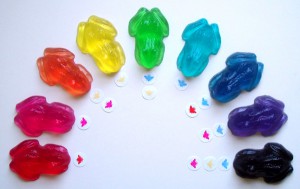 Gorgeous colors created by Debbie Chialtas using the Jewelry Box colorant collection.
Freshness: Melt and pour soap should be wrapped in some kind of plastic. You can bag it or wrap it as long as you protect it from moisture. Any moisture in the air will cause glycerin in the soap to form small beads on the soap’s surface, also known as glycerin dew or sweat. Like cold process soap, it could also go moldy if you add too many botanicals or if they’re too fresh. For example, if you like to add fruit to your soap. Dried botanicals and fruit powders will work best.
Hardness: Bar hardness is generally not an issue with melt and pour soap unless you add extra oils. Doing so can make the bar softer and decrease lather.
Labeling: As mentioned in Part One, true soap doesn’t require an ingredient label. Your soap is true soap if it is made of fats and an alkali (lye). Check with your supplier to see if the soap base is made of fats and lye, synthetic detergents or a combination. If your soap base is made from synthetic detergents it is considered a cosmetic and must have all ingredients listed. If you buy your bases from Bramble Berry, every listing on the site includes the ingredients. Aside from ingredients, other information may be required by law (product weight and contact information) or desired by your customers (scent). It may be the only chance you have to communicate with your buyer. There is a great book called Soap and Cosmetic Labeling that will help you make sense of all of the rules. You can also read this page on the FDA site. If you decide that your soap is true soap, your customers will appreciate you listing the ingredients even if it’s not required.
Selling in the sun: If you’re selling melt and pour soap at an outdoor event, you soap can and will melt in the sun. In addition, the sun will fade out the colors. Keep your product cool and shaded.
In Part One, I talked about general issues like labels and packaging. Part Two discussed issues specific to selling cold process soap.
Written by: Kim Wilton of Pepo Park. Thanks to Erin Pikor of Naiad Soap Arts for contributing her knowledge of melt and pour soap making.
